
Englewood Previous Residents By Era
Each source answers a different part of an address history. The Bergen land index establishes recorded transfers in its online period. Directories and census schedules can add names associated with an address. Newspapers and maps add dates and physical context. The table keeps the known coverage separate from the unverified bridge, so an empty online search is not mistaken for the start of the property’s history.
| Source | Years It Covers | Where Held | What It Shows |
|---|---|---|---|
| Bergen online land index | 1970-present | Bergen County Clerk web search | Deeds, mortgages, and other indexed land documents |
| Bergen deed guide and microfilm | 1715-1901 | New Jersey State Archives and county originals | Grantor/grantee deed books and legal descriptions |
| Intervening county deeds | 1902-1969 | County books, microfilm, or FamilySearch lead | Exact digital or index route not verified |
| Tillotson directory | 1900 | Newberry Library microfiche 3827 | Name, address, and possible line details to verify |
| Englewood telephone directories | 1959, 1961 | Bergen County Historical Society library | Listed subscriber and address clues |
| The Englewood Press | 1890-1982 | Englewood Public Library digital archive | Notices, obituaries, sales, events, and names |
| Sanborn maps | 1884-1929 selected editions | Princeton and Library of Congress | Building footprint, use, and street setting |
| Federal census | 1790-1950 | Census, NARA, and FamilySearch routes | Household composition and enumeration address |
Start with the newest public property record, then move backward. For a modern construction date, Englewood’s SDL inspection channel has been used since 2024; older permit results were not published as a public searchable run. A request to Building and Code can still ask for the public portion of an address file. The online land result is an index lead, not the whole answer. Preserve its grantor, grantee, recording date, document type, book-and-page or document identifier, and legal description before moving on. Those details are what make an archive request or a later cross-check practical.
Note: The 1902-1969 bridge is not a verified online run, so keep that era separate until a custodian identifies the source.
Englewood Previous Residents Starting File
Save the current parcel information before opening the land index. The Bergen property-search entry point, the county parcel viewer, and the municipal assessor are the current starting channels. Capture the tax owner exactly as displayed, the mailing address if shown, municipality, block and lot, legal description, situs address, and the date searched. A tax list is an annual snapshot, so a recent transfer can lag until the next list. A mailing address can help locate a record, but it does not prove who was present at the property.
| Tax owner | The current indexed name to search as the latest grantee. |
|---|---|
| Block and lot | New Jersey tax-map identifiers that help connect an old deed to a parcel. |
| Legal description | The deed’s property wording, stronger than a changing street label. |
| Situs and mailing address | Keep both distinct, since one is the parcel location and the other is correspondence information. |
Englewood’s assessor is listed by Bergen County at 201-871-6621 ext. 712. Ask the assessor for a current parcel card or tax-list entry when the map and the deed do not line up. A local card-copy fee was not located in the research.
Englewood Previous Residents Deed Chain
The Bergen County Clerk land-record search confirms public documents recorded from January 1, 1970 to the present. Search the current tax owner as a grantee, then compare municipality, block and lot, and the legal description in the newest deed. The seller, or grantor, becomes the next name to search as a grantee for the earlier purchase. Repeat the comparison at every link. An older deed may omit a familiar street address, and a larger tract, split parcel, or undivided interest can make a name match misleading.
- Record the current tax owner, block and lot, and legal description from the parcel card.
- Find that owner as grantee in the newest recorded deed and save its date and document or book-and-page reference.
- Read the grantor as the preceding owner, then search that person or entity as grantee for the earlier acquisition.
- Compare the legal description at each step rather than relying only on the street number.
- When the online trail ends, carry the legal description and document reference to the county records counter or archival finding aid.
- Grantor
- The party transferring an interest in the deed.
- Grantee
- The party receiving the interest. In a backward chain, a prior seller is searched as an earlier grantee.
- Chain of title
- The dated sequence of recorded property transfers, not a complete household chronology.
- Legal description
- The property wording in a deed, often tied to lot, tract, or subdivision details rather than a street address.
The Bergen land-record public search is the documented online entry point for the current deed chain.
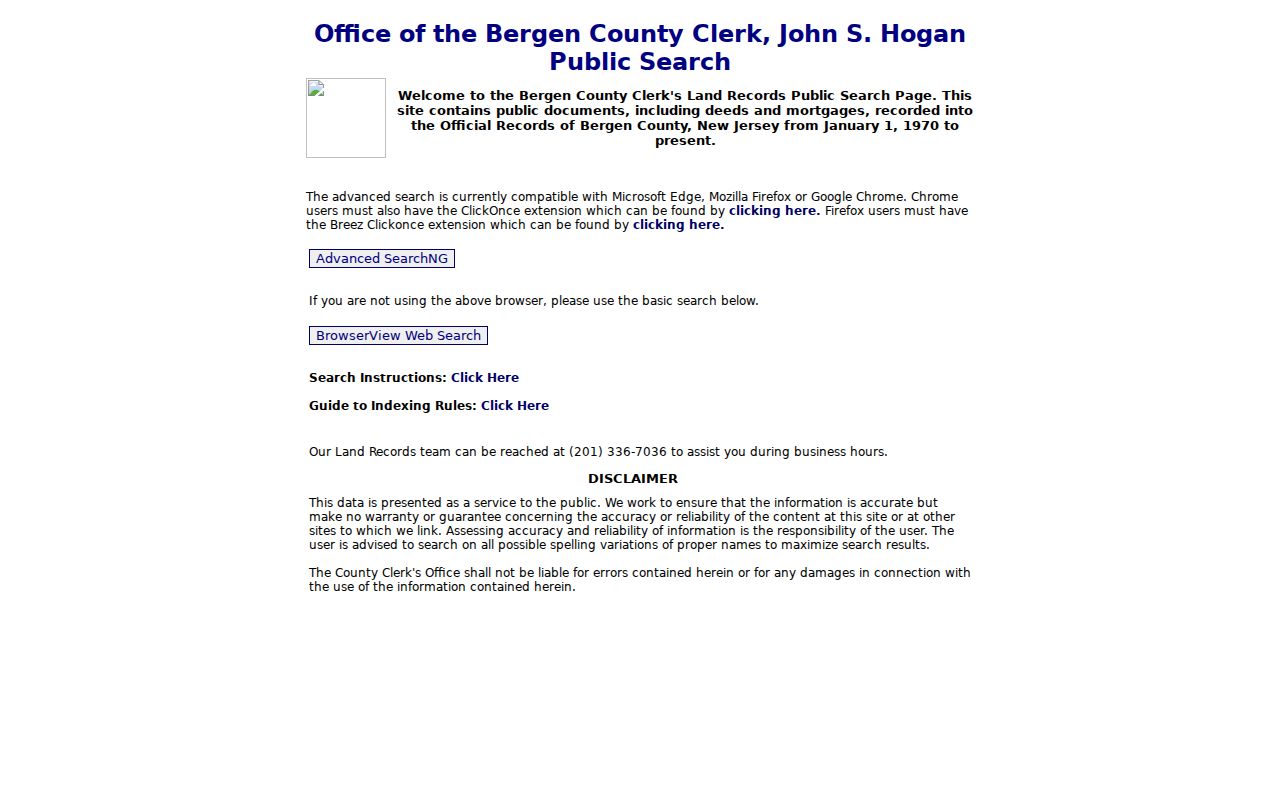
The Clerk advises searchers to test spelling variations. A deed entry should be checked against its legal description before it is assigned to the Englewood address.
Englewood Previous Residents 1970 Gap
The web index’s January 1, 1970 start is a key limit for Englewood address history. Bergen deed records are much older: the New Jersey State Archives guide covers Bergen County deeds from 1715 through 1901. The exact access route for the 1902-1969 bridge was not verified. Do not fill that period with guesses. Take the legal description, book and page or document number, and name variants to Bergen Land Records Management at One Bergen County Plaza, Room 150, Hackensack. The county directory lists 201-336-7034 and 201-336-7036 for this route.
New Jersey State Archives searchable collections provide the broader archival route for county deeds, census, court, probate, and vital material.
The Archives’ Bergen deed finding aid is an early-record bridge, while the County Clerk’s public web search handles the confirmed 1970-present period. Keep the gap labeled until a custodian confirms the exact source.
Note: Bring the legal description as well as a street address, since historic deeds may not use the current street form.
Englewood Previous Residents Household Layer
A title chain tells who held a recorded property interest. It does not prove a full household sequence. Pair each transfer date with the nearest directory, census, press notice, permit, obituary, or probate file. The 1900 Tillotson lead, BCHS’s 1959 and 1961 telephone books, and The Englewood Press can supply dated name-and-address clues. The Englewood city directory collections hold the collection details and the cautions for reading a historical entry. Census schedules add household composition, while a press page can connect a move, death, event, or family relation.
Household trail: current parcel card → recorded deed chain → dated directory or telephone clue → nearest census → press or obituary → probate or later deed. This sequence separates property ownership from the people who may have been connected with the address at a particular time.
When an estate, trust, or company appears, find the preceding natural-person deed first, then check the entity through the state business record route only if the public filing is relevant. For combined or divided land, compare the old lot number, subdivision material, street frontage, and legal description before joining one address to another. New Jersey state census schedules for 1855-1915 were taken every ten years ending in five, with 1915 the last. They can supply a local bridge when a federal decade or a directory year leaves a gap.
Englewood Previous Residents Map Clues
Sanborn maps can place an old address in a physical setting even though they do not name the people there. The confirmed Englewood editions are 1884, 1890, 1896, 1902, 1908, 1915, 1922, and 1929. Compare an edition to the closest deed or directory date, then look for building footprint, stories, use, outbuildings, and the street pattern. A later subdivision or changed parcel boundary can explain why a modern address does not appear in the same form on an early map.
The Princeton Englewood Sanborn index lists the available editions. Use map evidence with the legal description, never as a substitute for it.
Englewood Previous Residents Boundaries
Jurisdiction names are part of an address search. Englewood was laid out in 1859, became part of an Englewood township arrangement in 1871, began city incorporation in 1896, and completed it in 1899. Teaneck separated in 1891 and Englewood Cliffs in 1895. An older record may therefore use Englewood Township or a broader Englewood reference rather than today’s city label. No official source located a specific Englewood street-renumbering year, so a renumbering claim should not be used to force a match.
Search the place names used at the record’s date and follow the legal description. This is often more reliable than projecting a current street label backward.
Note: Treat a historic address mismatch as a research question, not evidence that the parcel or person is unrelated.
Brookside’s 1877 Chapel Move
One Englewood landmark can connect several types of historical evidence. The original Presbyterian chapel, founded in 1860, moved to Brookside Cemetery on Engle Street in 1877. For a family associated with that part of the city, a church history, cemetery inquiry, obituary, or press notice may add a date that a deed alone cannot provide. The Englewood Historical Society works with the library to preserve historic documents and artifacts and offers a Then & Now house-tour project.
Englewood Previous Residents Limits
Address history is best used for family history, estate questions, historic-property research, and personal curiosity. Treat personal details with care. An owner name may be different from a person connected with the address, and protected information may be absent. New Jersey’s Address Confidentiality Program can provide a substitute address in new state and local records, while Daniel’s Law protects covered people’s home information. Sealed records remain outside an ordinary request channel.
When an Englewood municipal record is not posted, a written and specific request under the New Jersey Open Public Records Act, P.L. 2001, c.404, N.J.S.A. 47:1A-1 et seq., goes to the proper custodian. An OPRA request does not override privacy, court, vital-record, or protected-person rules.
Lawful use. Use Englewood previous-resident records for a legitimate personal or historical purpose. Do not use information from public sources to stalk, harass, or harm any person.